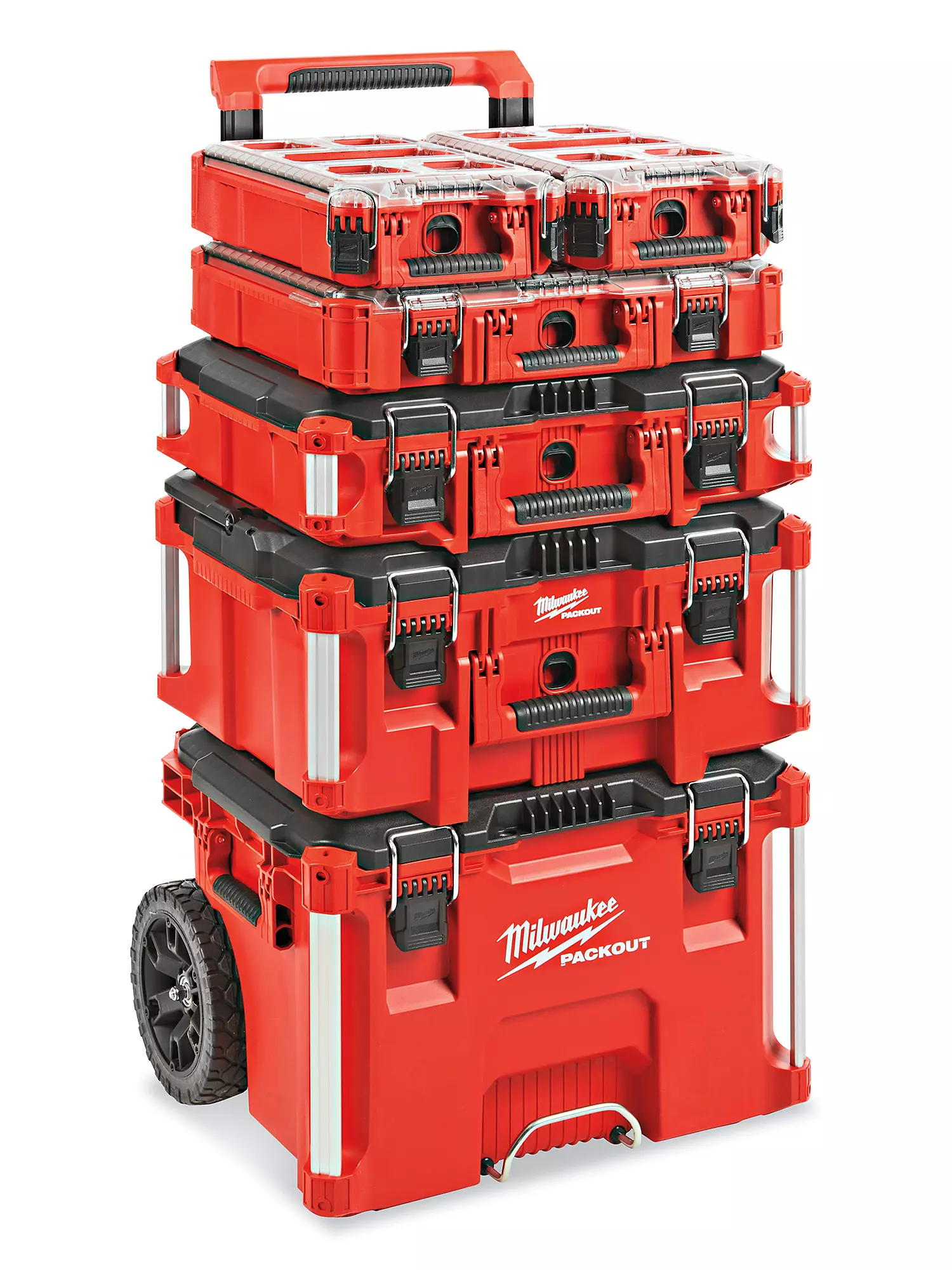
Milwaukee Packout: The Missing User Manual
Most toolboxes solve one problem: where do the tools go when you’re done. Milwaukee’s Packout — and its rivals like DeWalt’s ToughSystem 2.0, Ridgid’s Pro Gear, Husky’s Build-Out, Ryobi Link, and Toughbuilt’s StackTech — solves a different one: how does the right set of tools travel to the right place without you repacking everything every time.
That distinction sounds small. It isn’t. And nobody hands you a manual explaining it, which is exactly the kind of gap this blog exists to fill.
What it actually is (and why “modular” matters)
A Packout box is not really a box. It’s one node in a system. Every component — tool boxes, drawer units, organizers, totes, even compatible lights, radios, and vacuums — shares the same interlocking footprint. Feet on the top, receiver slots on the bottom, and latches that grab the unit above and below at the same time. You snap pieces into a stack, and the whole stack becomes one rigid unit you can roll or carry by the top handle.
Milwaukee launched the system in 2018 with eight products. It’s now past 100, and the competitors have all built their own walled gardens to match. The number matters less than the idea: you’re not buying a toolbox, you’re buying into a connector standard. Once you own the standard, every future purchase either extends your stack or it doesn’t fit at all.
The genuinely clever part is the 4-way latching. On older stacking systems, getting to the bottom box meant lifting everything off the top first. Here, you can unlatch a unit from the middle of a stack and pull it out without dismantling the tower. It’s the difference between a filing cabinet and a pile of paper.
Why this is the right tool for the “multiple locations” person
Here’s the use case the marketing never quite names, because it’s chasing electricians and plumbers: the person who isn’t a tradesperson but is responsible for keeping several properties or sites running.
Think about who that actually is:
- Someone maintaining a primary home, a rental, and a parents’ place across town.
- A small landlord with three or four units.
- A homeowner with a detached shop, a vehicle they wrench on, and a yard with equipment.
- Anyone whose “weekend” means driving to wherever the current problem is.
For this person, the enemy isn’t a lack of tools. It’s logistics. You own the right wrench. It’s just at the other house. You spend more time assembling a kit for today’s job — and discovering what you forgot when you arrive — than doing the job.
Modular storage attacks that directly in a few ways:
- Pre-built, grab-and-go kits. Instead of one giant toolbox you ransack every time, you build purpose stacks — a plumbing organizer, an electrical box, a general-repair tote. Grab the two or three modules the job needs and leave the rest. The kit is already correct because you built it once, deliberately.
- One-trip transport. Stack three units on a rolling base and move a workshop’s worth of gear from the truck to the basement in a single haul.
- A consistent home at each location. Leave a base stack at each property and only shuttle the specialty modules. Locations stop competing for the same physical tools.
- Weatherproofing that survives a truck bed. The better boxes carry IP-rated weather seals and impact-resistant shells — the difference between dry tools and a rusty surprise.
A starter setup that actually works
You don’t need 100 components. A practical multi-location starter looks like this:
- A rolling base box — the foundation everything stacks onto and the thing that carries the weight (rolling units typically handle ~250 lbs of stack).
- One or two organizers with adjustable, removable bins — for fasteners, fittings, and small parts sorted by job, not by type.
- A mid-size tool box for your hand tools and the cordless drill/driver everyone reaches for first.
- A tote or open carrier for the awkward stuff — caulk guns, a level, things that don’t sit in trays.
Build that, use it for a month, and you’ll know exactly which fifth and sixth pieces you actually need. That’s the right way to grow into it — by demand, not by catalog.
”Or any similar brand” — the honest part
Packout has the largest ecosystem, but it is not the only good answer, and the systems do not cross-connect. Pick your standard before you spend, because switching later means re-buying.
- DeWalt ToughSystem 2.0 — arguably the most secure latching of the bunch; strong if you already live in DeWalt’s battery world.
- Ridgid Pro Gear / Husky Build-Out — frequently better value; Husky in particular is the budget-conscious pick at the big-box store.
- Ryobi Link — the natural choice if your cordless tools are already Ryobi; lighter-duty but cheaper.
- Toughbuilt StackTech — newer, with some genuinely clever one-handed latching.
The right pick is usually the one that matches the cordless battery platform you already own, because the lights, radios, and vacuums that clip into the same stack only come in that brand’s flavor. Your toolbox decision and your battery decision are quietly the same decision.
Where it’s not worth it
This isn’t a free win for everyone. Be honest with yourself:
- If everything you own lives in one garage and never moves, a wall of cheap drawers stores more for less money. Modularity you don’t use is just an expensive premium.
- The cost adds up fast. A serious stack runs into the hundreds. The system rewards people who move tools; it punishes people who just store them.
- Capacity-per-dollar is lower than a plain toolbox. You’re paying for the connectors and the engineering, not raw volume.
The bottom line
The innovation here isn’t a sturdier box — it’s treating storage as a platform instead of a container. For a pro, that’s productivity. For the non-pro juggling a house, a shop, a vehicle, and somebody else’s place across town, it’s something better: the kit is always already packed, it travels in one trip, and you stop losing Saturdays to the tool you own but left behind.
That’s the missing user manual. The boxes are just boxes. The system is the point.