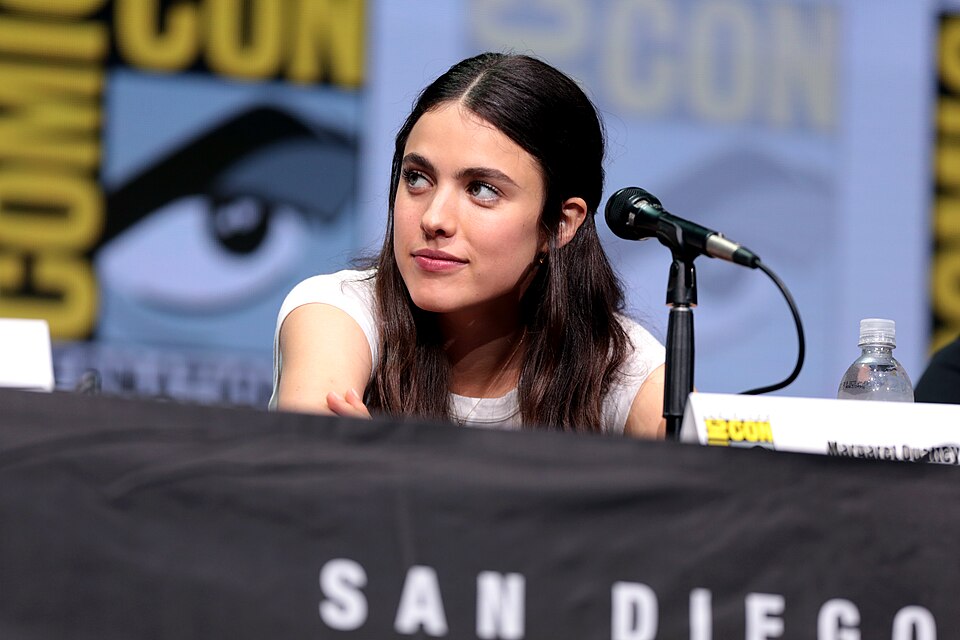
Margaret Qualley Is Quietly Becoming the Hardest-Working Actor in the Room
There’s a particular kind of career moment that’s easy to miss while it’s happening, because it doesn’t announce itself with a single blockbuster. It just… accumulates. Margaret Qualley is having that moment. Look at her last two years and the pattern is unmistakable: she’s not chasing roles, she’s collecting collaborators — and the directors she’s working with read like a syllabus for modern American filmmaking.
Yes, she’s striking. The camera obviously loves her, and she came up as a trained ballerina and model before she ever read for a part, so there’s a physical control to her performances that’s hard to fake. But here’s the thing the “she’s gorgeous” angle keeps missing: plenty of beautiful people get one good role and vanish. Qualley keeps getting cast again, by the same exacting filmmakers, which tells you the look is the least interesting thing about her.
The run that built the buzz
Her recent filmography is genuinely stacked. She played Sue in Coralie Fargeat’s The Substance (2024) opposite Demi Moore — a brutal, committed body-horror performance that put her in the awards conversation. Before that she was Felicity in Yorgos Lanthimos’s Poor Things (2023) and turned up again in his Kinds of Kindness (2024), the kind of repeat invitation Lanthimos doesn’t hand out lightly. She anchored Ethan Coen’s Drive-Away Dolls (2024), then came right back for his follow-up Honey Don’t! (2025) as private investigator Honey O’Donahue, alongside Aubrey Plaza and Chris Evans.
That’s the tell. Lanthimos twice. Coen twice. These aren’t directors who recast people out of habit — they recast people who deliver.
Range, on display
What makes the streak more impressive is how little the roles resemble each other. In the same stretch she went from prestige surrealism (Poor Things) to grindhouse comedy (Honey Don’t!) to broad studio comedy in Happy Gilmore 2 (2025) to a turn as Elizabeth Weiland in Richard Linklater’s Blue Moon (2025) — a film she called life-changing simply for getting to work in the room with Linklater and Ethan Hawke. She even voiced a character in the Death Stranding 2 video game. That’s a performer testing the edges of what she can do rather than settling into a lane.
What’s next
The pipeline shows no sign of slowing. She stars in How to Make a Killing (early 2026) and is set to appear opposite Jacob Elordi in The Dog Stars, plus a horror-thriller turn as an unsettling governess named Winifred Notty in an A24 gothic. More projects sit in post-production and pre-production behind those.
So if it feels like Qualley is suddenly everywhere, that’s not an illusion and it’s not just good lighting. It’s a working actor in the middle of a deliberate, director-driven hot streak — the kind that, a decade from now, people will point to as the moment she went from “Andie MacDowell’s daughter” to simply one of the most reliable names on a call sheet.
New to her? Start here
If this post made you want to dig in, these four are the best on-ramps — in roughly the order I’d watch them:
- Maid (2021, Netflix) — Her career-defining lead. She carries nearly every scene as Alex, a young single mother escaping an abusive relationship, and earned Emmy, Golden Globe, SAG and Critics’ Choice nominations for it. Her real-life mother Andie MacDowell plays her mom. Start here.
- The Substance (2024, on Mubi / rental) — The body-horror phenomenon as Sue, the role that re-launched her into the awards conversation and earned a Golden Globe nod. Not for the squeamish, in the best way.
- Fosse/Verdon (2019, Hulu) — As dancer Ann Reinking, she puts her ballet training to work and got her first Emmy nomination. The most elegant showcase of her physicality.
- Once Upon a Time… in Hollywood (2019, digital rental) — A smaller but unforgettable turn as “Pussycat,” the Manson-girl who lures in Brad Pitt’s stuntman. Great proof of how much she does with limited screen time.
Deep-cut bonus for when you’re hooked: Novitiate (2017), an early indie where she plays a young nun in a crisis of faith — an early sign of everything she’d become.